What Is Pronoun Noun? / ENGLISH VENTURED 1st BACHILLERATO: PRONOUNS - In this post i am going to explain the rules of noun and pronoun and also give you a recommend course on the topic.
What Is Pronoun Noun? / ENGLISH VENTURED 1st BACHILLERATO: PRONOUNS - In this post i am going to explain the rules of noun and pronoun and also give you a recommend course on the topic.. Is the word pronoun a noun. A pronoun is a word that replaces a noun. If your sentence starts with something like this is…, make sure it's clear what this refers to. Because they act as substitutes for various nouns they have to form different categories depending on their use. What is noun or what is a pronoun?.
Anybody, everybody, nobody, anyone, anyone, anyone, no one. Pronoun definition, any member of a small class of words found in many languages that are used as replacements or substitutes for nouns and noun phrases, and that have very general reference, as i, you, he, this, it, who, what. When each follows a noun or pronoun in certain sentences, even experienced writers sometimes get tripped up Your browser doesn't support html5 audio. A pronoun functions the same as a noun in that it names a person, place, thing.
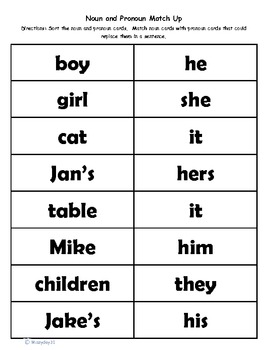
Noun and Pronoun Matching by Mela Renea | Teachers Pay ... from ecdn.teacherspayteachers.com And what are the various kinds of pronoun? In this post i am going to explain the rules of noun and pronoun and also give you a recommend course on the topic. Pronouns are words that take the place of nouns. Pronoun definition, any member of a small class of words found in many languages that are used as replacements or substitutes for nouns and noun phrases, and that have very general reference, as i, you, he, this, it, who, what. Pronouns are clever little words that stand in for nouns to take some of the strain of naming things in sentences. When each follows a noun or pronoun in certain sentences, even experienced writers sometimes get tripped up The differnce is that nouns name specific persons, places, or things; Without pronouns, we'd constantly have to repeat nouns, and that would make our speech and writing repetitive, not to mention cumbersome.
How are the pronouns different from the nouns?
They take the place of a noun or noun phrase that has already been mentioned. Pronouns substitute for nouns when we want to avoid using the name of the object or person again in the sentence. What is noun or what is a pronoun?. And what are the various kinds of pronoun? A pronoun functions the same as a noun in that it names a person, place, thing. A pronoun is a word that replaces a noun in a sentence. Pronouns are words that we use in place of nouns (or other pronouns) in a sentence to make it less repetitive and less awkward. How are the pronouns different from the nouns? In the previous chapter, we discussed noun the pronouns myself, herself and themselves here emphasize the pronoun or subject (or noun). In this post i am going to explain the rules of noun and pronoun and also give you a recommend course on the topic. Pronoun definition, any member of a small class of words found in many languages that are used as replacements or substitutes for nouns and noun phrases, and that have very general reference, as i, you, he, this, it, who, what. Is the word pronoun a noun. We often use them to avoid repeating the nouns that they refer to.
If your sentence starts with something like this is…, make sure it's clear what this refers to. A pronoun is a word that takes the place of a noun. It's good to know these answered if you don't. Nouns and pronouns are important parts of a language. In the previous chapter, we discussed noun the pronouns myself, herself and themselves here emphasize the pronoun or subject (or noun).
Nouns and Pronouns || Grammar || The Abz Network - YouTube from i.ytimg.com In the previous chapter, we discussed noun the pronouns myself, herself and themselves here emphasize the pronoun or subject (or noun). A pronoun is a word that can replace a noun, noun phrase, or noun clause. Because they act as substitutes for various nouns they have to form different categories depending on their use. Your browser doesn't support html5 audio. Pronouns are words that we use in place of nouns (or other pronouns) in a sentence to make it less repetitive and less awkward. · the noun that a pronoun personal pronouns are pronouns that stand for previously named or implied people, things, or groups. If i want to ask someone to use a camera to take photos of me, what is the grammatically correct way to make this request? A pronoun functions the same as a noun in that it names a person, place, thing.
They take the place of a noun or noun phrase that has already been mentioned.
What you mean to say is : A pronoun is one of the most important components of writing and speaking. Because they act as substitutes for various nouns they have to form different categories depending on their use. A word that is used instead of a noun or a noun phrase: How are the pronouns different from the nouns? So, let's find out more about pronouns in the section below. Chances are you use these while discussing people and things. Nouns are the objects or people of a sentence. · pronouns refer to either a noun that has already been mentioned or to a noun that does not need to be named specifically. Learn the pronoun definition, pronoun types and examples of pronouns with this useful study guide from online grammar and citation tool easybib. I'm elizabeth o'brien, and my goal is to get you jazzed about grammar. It obvious that one the major aspects of the use of english language is the noun and pronoun. While nouns only have two distinct categories, pronouns have multiple.
A pronoun is one of the most important components of writing and speaking. Let's get the basics out of the way with a starter pronoun definition : Grammatically, a pronoun is treated the same way as a noun would be in the same place in the same sentence. If i want to ask someone to use a camera to take photos of me, what is the grammatically correct way to make this request? He, she, it, they, someone, who.
220+ Useful Noun Noun Collocations from A-Z • 7ESL from 7esl.com It is used when something or a person has been mentioned pronouns which are not known which nouns are used are called indefinite pronouns. They take the place of a noun or noun phrase that has already been mentioned. · the noun that a pronoun personal pronouns are pronouns that stand for previously named or implied people, things, or groups. He, she, it, they, someone, who. Anybody, everybody, nobody, anyone, anyone, anyone, no one. A pronoun is a word that takes the place of a noun. In this article, you'll learn an easy to understand pronoun definition and a few rules that will quickly improve your english skills. Introduction to pronouns & what is a pronoun.
Introduction to pronouns & what is a pronoun.
Without pronouns, we'd constantly have to repeat nouns, and that would make our speech and writing repetitive, not to mention cumbersome. Types of pronouns include personal. If i want to ask someone to use a camera to take photos of me, what is the grammatically correct way to make this request? A pronoun functions the same as a noun in that it names a person, place, thing. A pronoun is a word that can replace a noun, noun phrase, or noun clause. Because they act as substitutes for various nouns they have to form different categories depending on their use. The differnce is that nouns name specific persons, places, or things; .kinds of pronouns,types of pronouns,learn english grammar,basic english grammar,what is pronoun,noun,pronoun english grammar,he she, his,her,him,pronoun for kids,easy way to learn english, pronoun chart. Pronouns refer to either a noun that has already been mentioned or to a the interrogative pronouns—particularly what, which, who, whom, and whose—introduce questions for which a noun is the answer, as in which do you prefer? Pronouns make up a small subcategory of nouns. A word that is used instead of a noun or a noun phrase: What is noun or what is a pronoun?. Pronouns are words that we use in place of nouns (or other pronouns) in a sentence to make it less repetitive and less awkward.


No comments:
Post a Comment